Percent Error Formula: Ultimate Guide to Calculate Experimental Errors in Chemistry, Physics & Biology Labs
The Moment Every Lab Student Dreads
Picture this: You're in the chemistry lab, goggles fogging up slightly from the Bunsen burner, meticulously measuring the mass of a copper cylinder on the analytical balance. You've calculated its density—your experimental value is 8.93 g/cm³. The textbook says 8.96 g/cm³ for copper. A tiny discrepancy, but your heart sinks. Is it a mistake? Poor technique? Or just the nature of real-world experimentation?
This scenario plays out in labs worldwide, from high school benches to university research suites. It's not failure—it's science. Enter the percent error formula, your trusty tool for quantifying how close your experimental results are to the accepted truth. Mastering how to calculate percent error isn't just for acing lab reports; it's the backbone of reliable scientific inquiry in chemistry, physics, and biology.
In this ultimate guide, we'll demystify the percent error formula for chemistry labs, walk through real-world examples across disciplines, dodge common traps, and arm you with pro tips. Whether you're drafting chemistry lab report help or tackling physics percent error calculations, you'll finish confident and precise.
The Percent Error Formula: Your Lab Lifeline
At its core, percent error measures the accuracy of an experiment by comparing your measured (experimental) value to the known or theoretical value. The formula is straightforward yet powerful:
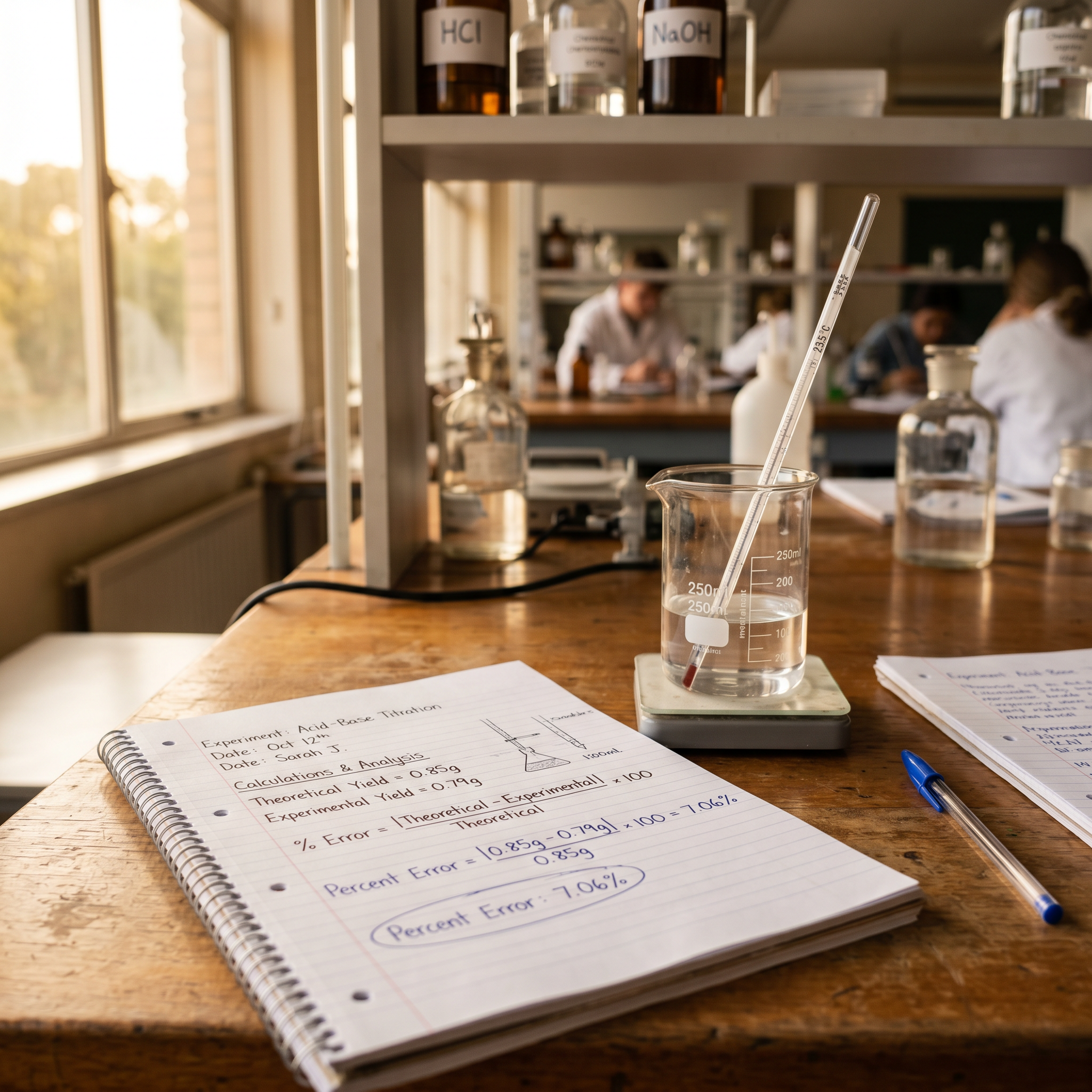
Percent Error = (|Experimental Value - Theoretical Value| / Theoretical Value) × 100
Break it down: Subtract the theoretical from the experimental, wrap it in absolute value bars (those crucial | | symbols ensure the result is always positive, regardless of over- or under-estimation), divide by the theoretical value, and multiply by 100 for a percentage. This yields the experimental error as a relative measure—perfect for comparing results across scales.
Why absolute value? Science doesn't care if you're consistently high or low; it wants magnitude. And percentage? It normalizes the error, making a 0.1 g discrepancy in a 1 g sample (10%) more alarming than the same in a 100 g sample (0.1%).
Ready to apply it? Let's dive into examples starting with chemistry.
Percent Error Formula in Chemistry: Density of Copper Lab
Density labs are a rite of passage. Suppose you measure a copper sample: mass = 25.0 g, volume (via water displacement) = 2.79 cm³.
Step-by-Step Calculation
- Experimental density = mass / volume = 25.0 g / 2.79 cm³ = 8.96 g/cm³ (spot on? Wait for it).
- Theoretical density of copper = 8.96 g/cm³.
- Difference: |8.96 - 8.96| = 0.
- Percent error = (0 / 8.96) × 100 = 0%. Perfection!
But reality bites. Recalibrate: Your actual measurement was volume = 2.80 cm³, so density = 25.0 / 2.80 = 8.93 g/cm³.
- Difference: |8.93 - 8.96| = 0.03.
- Percent error = (0.03 / 8.96) × 100 ≈ 0.33%.
A stellar result for a student lab, highlighting how small tweaks in measurement amplify in the percent error formula chemistry context. Use this in your lab report to showcase precision.
Physics Percent Error: Measuring Gravity with a Pendulum
Physics labs love pendulums for g ≈ 9.81 m/s². You set up a 1.00 m string, time 10 oscillations: total time 20.1 s, so period T = 2.01 s.
Crunch the Numbers
Formula for g: g = 4π²L / T².
- T² = (2.01)² ≈ 4.0401 s².
- g experimental = 4(9.8696)(1.00) / 4.0401 ≈ 9.74 m/s².
- Theoretical g = 9.81 m/s².
- Percent error = |9.74 - 9.81| / 9.81 × 100 ≈ 0.71%.
Air resistance or imprecise length? This calculate percent error exercise reveals sources of experimental error, teaching iterative improvement.
Biology Percent Error: Population Estimation
Biology isn't always microscopes; think mark-recapture for pond critters. Actual fish population: 500. You mark 100, release, recapture 80 with 20 marked.
Lincoln-Petersen Estimate
- Population estimate = (100 × 80) / 20 = 400.
- Theoretical (actual) = 500.
- Percent error = |400 - 500| / 500 × 100 = 20%.
Higher error due to sampling variability—biology's wild card. Still vital for ecological reports.
Percent Error vs. Percent Difference: Know When to Use Each
Percent error compares to a known standard (theoretical value). Percent difference? Between two experimental values, no "truth" needed: (|Value1 - Value2| / |(Value1 + Value2)/2|) × 100.
- Use error for validation against literature.
- Difference for comparing lab partners' results or replicates.
Mix them up, and your chemistry lab report help section confuses graders.
Common Pitfalls in Calculating Percent Error
- Swapping values: Experimental in denominator? Wrong benchmark.
- Forgetting absolute value: Negative errors mislead.
- Units mismatch: g/cm³ vs. kg/m³? Convert first!
- Zero theoretical: Division by zero—use relative error alternatives.
Double-check; these trip up even pros.
Pro Tips for Minimizing Experimental Error in Labs
- Calibrate instruments: Zero balances, standardize pipettes.
- Multiple trials: Average 5+ runs, report standard deviation.
- Avoid parallax: Eye level for volumes; use digital where possible.
- Control variables: Temperature, humidity—log them.
- Peer review data: Fresh eyes catch blunders.
These boost accuracy, slashing percent error and impressing instructors.
FAQ: Your Burning Questions on Percent Error
Can percent error be negative?
No—the absolute value ensures it's always positive, focusing on magnitude over direction.
What is a 'good' percent error?
Context-dependent: <1% elite physics; 5-10% solid biology; >20% flags issues. Aim lower with practice.
Why do we multiply by 100?
Converts decimal fraction to intuitive percentage (e.g., 0.05 → 5%).
What if my experimental value is way off?
Analyze: systematic (equipment bias) vs. random (fluctuations). Iterate experiments.
Master Percent Error—Elevate Your Lab Game
From copper densities to gravity swings and fish counts, the percent error formula bridges theory and practice. Embrace it: low errors validate your skills, high ones fuel discovery.
Verify instantly with our free tool: Percent Error calculator at getpercentconvert.com/percent-error. Plug in values, get results—perfect for lab reports. Experiment boldly; calculate wisely.