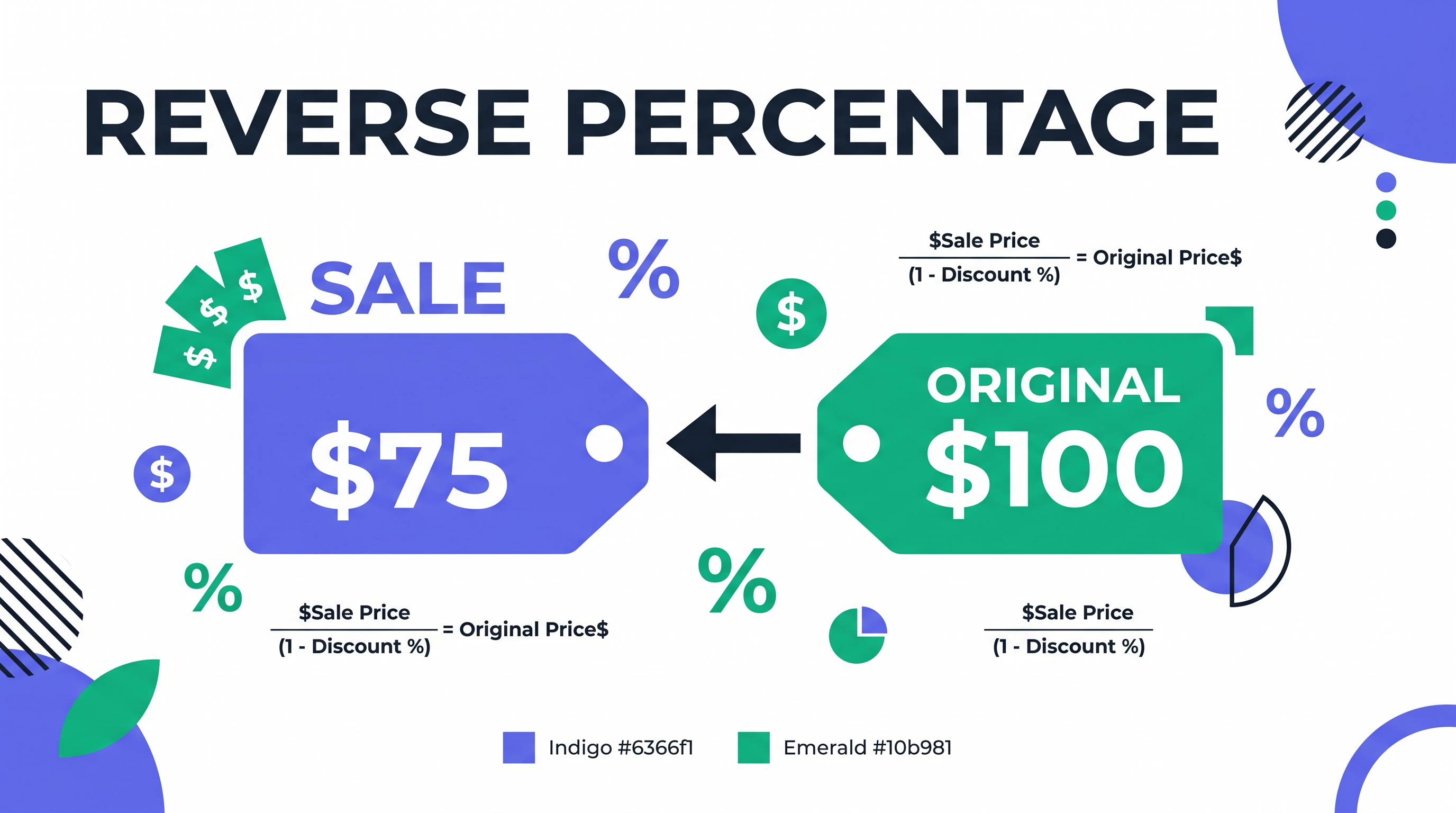
Reverse Percentage Calculator: How to Find Original Price from Discount (Formula, Examples & Guide)
Picture this: You're strolling through a bustling department store, eyes locked on a sleek pair of sneakers slashed to $72 after a "20% off" sign screams bargain. Your heart races—deal of the century? But a nagging question hits: What was the original price before that discount kicked in? Was it $90? $100? Knowing the answer could mean spotting true value amid the sales frenzy.
This everyday puzzle stumps shoppers, small business owners verifying supplier markups, and students tackling math homework. Enter the reverse percentage calculator—your secret weapon to find original price from discount. No more guesswork. In this guide, we'll demystify the reverse percentage formula, break down how to calculate original price from percentage discounts, and arm you with real-world examples. Whether you're hunting retail steals or decoding business taxes, mastery here saves money and sharpens your financial edge.
What Is Reverse Percentage Calculation?
Traditional percentage math flows one way: from original price to discounted price. Think 20% off $100 equals $80. But life flips the script. You see the sale price and discount rate, needing the original. That's reverse percentage—working backward like unraveling a ball of yarn to find its start.
Shoppers use it for sale validation. Small business owners reverse-engineer competitor pricing or pre-tax costs. Students apply it in algebra, finance classes, or even economics projects. At its core, it's algebra disguised as practicality: solving for the unknown original amount when you know the result and the percentage change.
The Reverse Percentage Formula: Step-by-Step Breakdown
PercentPro's reverse percentage formula is elegantly simple, yet powerful. Here's the magic:
Reverse Percentage Formula for Discounts
Original Price = Sale Price ÷ (1 - Discount Rate)
Where:
- Sale Price: What you pay (e.g., $80)
- Discount Rate: As decimal (20% = 0.20)
Why does it work? A 20% discount means you pay 80% of the original (100% - 20% = 80%, or 0.80). So, original = sale / 0.80. Boom—reverse engineering at its finest. PercentPro's tool flashes our step-by-step formulas and crystal-clear explanations, so you grasp every twist.
Quick Tip for Taxes/Markups
Original = Final Price ÷ (1 + Rate)
Taxes add on, so flip the sign.
How to Use the Reverse Percentage Formula: A Step-by-Step Guide
Ready to calculate? Follow these steps to find original price from discount manually—or plug into PercentPro's calculator for instant results.
- Identify the sale price and discount percentage. Example: $80 after 20% off.
- Convert percentage to decimal. 20% = 0.20.
- Subtract from 1. 1 - 0.20 = 0.80 (what you actually paid of original).
- Divide sale price by that fraction. $80 ÷ 0.80 = $100. Original price!
- Verify: 20% of $100 is $20 off, landing at $80. Perfect.
Pro move: Always double-check units. Percentages are out of 100, decimals between 0 and 1. PercentPro's explanation feature walks you through each step, preventing slip-ups.
Real-World Retail Examples: Cracking Common Discounts
Let's apply the reverse percentage formula to everyday sales. These scenarios mirror Black Friday hauls, back-to-school rushes, or boutique clearances.
10% Discount Example
Coffee maker on sale for $90 after 10% off. Original? $90 ÷ (1 - 0.10) = $90 ÷ 0.90 = $100. Modest markdown, but now you know its true starting point.
20% Discount Example
Those sneakers at $72. $72 ÷ (1 - 0.20) = $72 ÷ 0.80 = $90. Solid savings from $90—worth grabbing?
25% Discount Example
Dress reduced to $75. $75 ÷ (1 - 0.25) = $75 ÷ 0.75 = $100. A quarter off feels substantial when reversed.
40% Discount Example
Jacket for $60. $60 ÷ (1 - 0.40) = $60 ÷ 0.60 = $100. Whoa—from $100? That's the steal you sensed.
See the pattern? Bigger discounts amplify the original reveal. Use our reverse percentage calculator to test endless combos instantly.
Business Scenarios: Taxes, Markups, and Profit Reversals
Beyond shopping, small business owners wield this for taxes and markups. Imagine invoicing clients or auditing suppliers.
Reversing Sales Tax
Customer pays $108 including 8% tax. Pre-tax amount? $108 ÷ (1 + 0.08) = $108 ÷ 1.08 = $100. Essential for clean accounting.
Finding Cost from Markup
Selling widgets at $120 with 20% markup on cost. Original cost? $120 ÷ (1 + 0.20) = $120 ÷ 1.20 = $100. Profit margins clarified.
These flips power negotiations, budgeting, and compliance. PercentPro handles both discount subtractions and addition reversals seamlessly.
Why Choose PercentPro's Reverse Percentage Calculator?
Manual math risks errors—decimals slip, calculators fumble. Our tool delivers precision with step-by-step formulas and detailed explanations, building your confidence. Instant, free, no ads. Shoppers snag deals, owners optimize, students ace tests.
Reverse percentages turn confusion into clarity, one calculation at a time.
Ready to Master Reverse Percentages?
You've got the formula, examples, and insights. Now put it to work. Head to PercentPro's reverse percentage calculator today. Enter any sale price and discount—watch the original unveil itself. Smarter shopping, sharper business, straight-A math awaits.
What will you reverse first?