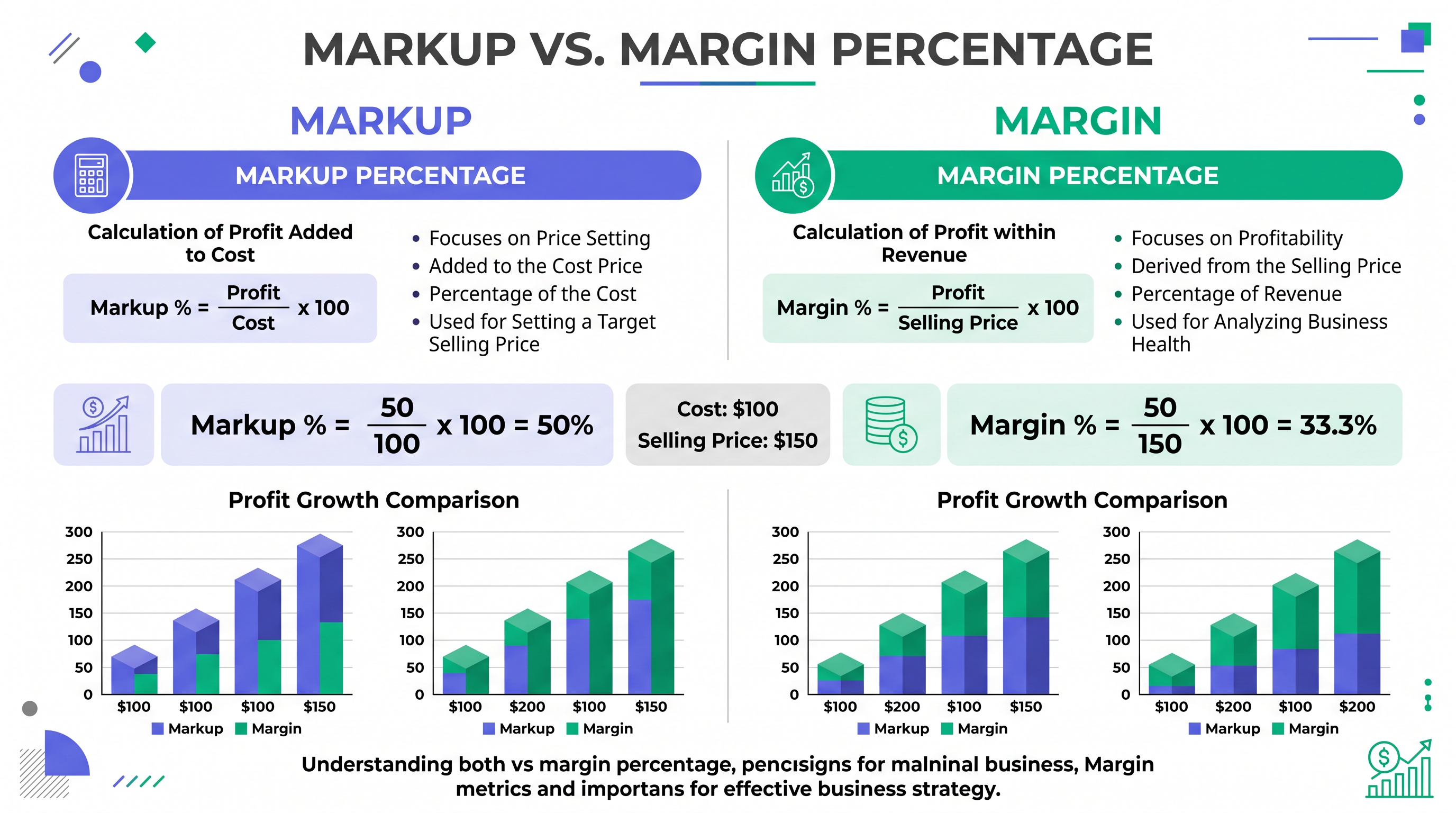
Markup vs Margin Percentage: Formulas, Examples, Calculator & Key Differences Explained
Unraveling the Common Confusion: Markup vs Margin Percentage
Imagine this: you snag inventory at $50 per unit and price it at $75 to stay competitive in your online store. Feels like a solid 50% profit, right? Wrong. That's where the markup vs margin percentage mix-up trips up small business owners, e-commerce sellers, and even seasoned retailers every day. These two metrics sound interchangeable but can lead to wildly different pricing decisions—and profit outcomes—if misunderstood.
At PercentPro on getpercentconvert.com, we demystify percentages to help you price smarter. Markup and margin both measure profitability as percentages, but they're calculated from different bases: cost versus revenue. Confusing them means overpricing (and losing sales) or underpricing (and slashing margins). In this guide, we'll break down definitions, formulas, real-world examples, a handy calculator method, and key differences—tailored for your business needs.
Whether you're dropshipping gadgets or running a brick-and-mortar shop, mastering markup vs margin percentage ensures sustainable growth. Let's dive in.
What is Markup Percentage? Definition and Formula
Markup percentage is the simplest way retailers think about pricing: it's how much you add to the cost price as a percentage of that cost. Picture buying wholesale widgets and slapping on a premium to cover overhead, shipping, and that well-deserved profit.
The how to calculate markup percentage formula is straightforward:
Markup % = (Gross Profit / Cost Price) × 100
Or, more practically: Markup % = ((Selling Price - Cost Price) / Cost Price) × 100. It's always relative to your input cost, making it intuitive for quick cost-plus pricing strategies common in retail.
Why love markup? For e-commerce sellers juggling suppliers, it's a fast rule of thumb. A 50% markup doubles your cost—easy to eyeball inventory needs without spreadsheets.
- Subtract cost from selling price to get gross profit.
- Divide gross profit by cost price.
- Multiply by 100 for the percentage.
Margin vs Markup Formula: Understanding Gross Profit Margin
Margin percentage shifts the perspective to your total revenue. It's the share of each sale that turns into gross profit after costs—a key metric for finance professionals analyzing overall health.
The gross profit margin calculation formula is:
Margin % = (Gross Profit / Revenue) × 100
Where Revenue = Selling Price. So: Margin % = ((Selling Price - Cost Price) / Selling Price) × 100. This view reveals how efficiently you're converting sales into profit, ideal for comparing against industry benchmarks (retail averages 20-50%).
For small business owners, margins spotlight scalability. High-volume e-commerce might chase slimmer margins for market share, while niche retailers protect fatter ones.
- Calculate gross profit (Selling Price - Cost).
- Divide by selling price (revenue).
- Multiply by 100.
The Core Difference: Why Markup vs Margin Percentage Matters
Here's the crux: markup is relative to cost, inflating with higher add-ons, while margin is relative to sales price, staying conservative. Same profit dollars? Markup always exceeds margin (except at zero). Why? Markup ignores the revenue base, overestimating profit share.
This gap dooms naive pricing. Aim for '50% profit' via markup, but report 33% margin to investors? Red flags. Retailers favor markup for daily ops; finance pros demand margins for P&L statements.
Pro tip: Markup = Margin / (1 - Margin). Margin = Markup / (1 + Markup). These conversions bridge worlds—perfect for hybrid decisions.
Side-by-Side Examples: Markup vs Margin in Action
Example 1: Cost $50, Selling Price $75
Classic scenario for a retailer flipping apparel.
- Gross Profit = $75 - $50 = $25
- Markup % = ($25 / $50) × 100 = 50%
- Margin % = ($25 / $75) × 100 = 33.3%
Note markup doubles cost; margin is one-third of sales. Markup is essentially a percentage increase from cost—try our Percentage Increase Calculator for instant checks.
Example 2: Cost $30, Selling Price $60
E-commerce gadget reseller vibe.
- Gross Profit = $60 - $30 = $30
- Markup % = ($30 / $30) × 100 = 100% (keystone pricing!)
- Margin % = ($30 / $60) × 100 = 50%
Perfect 50-50 split. Track changes over time with our Percentage Change Calculator.
Quick Reference Table: Markup vs Margin Conversions
No more mental math. This table shows common pairings—bookmark for pricing sessions.
| Markup Percentage | Margin Percentage |
|---|---|
| 10% | 9.09% |
| 20% | 16.67% |
| 25% | 20.00% |
| 30% | 23.08% |
| 40% | 28.57% |
| 50% | 33.33% |
| 60% | 37.50% |
| 75% | 42.86% |
| 100% | 50.00% |
| 200% | 66.67% |
Reverse lookup? For 40% target margin: Markup = 40 / (100 - 40) = 66.67%.
Markup vs Margin Calculator: DIY Method
No app needed—here's your markup vs margin calculator. Plug in numbers:
- Cost: $____
- Selling Price: $____
- Gross Profit = Selling - Cost
- Markup % = (Profit / Cost) × 100 = ____%
- Margin % = (Profit / Selling) × 100 = ____%
Example: Target 40% margin? Markup needed = 40 / 60 × 100 ≈ 66.7%. Scale for bulk: 100 units at $50 cost, 66.7% markup → $83.35 sell price, $3,335 profit.
Pricing Strategy: When to Use Markup vs Margin
Retailers: Lean on markup for speed. Keystone (100%) yields 50% margin—apparel staple. E-commerce: Mix with competition; 30-50% markup covers ads/returns.
Finance view: Margins rule. Track gross profit margin for taxes, loans. Below 20%? Rethink suppliers. High-ticket? 60%+ margins justify low volume.
Hybrid hack: Set margin goals, convert to markup. Adjust for channels—Amazon fees eat margins, so hike markup. Test: A/B price points, measure true profitability.
- Use Markup: Daily pricing, cost-plus, retail rules.
- Use Margin: Profit reports, benchmarks, scaling.
- Convert Always: Align teams.
Master Markup vs Margin: Price for Profit
Markup vs margin percentage isn't jargon—it's your profit edge. Markup fuels fast decisions; margin guards long-term viability. With formulas, examples, and our table, you're equipped to price confidently.
Ditch the confusion, boost bottom lines. Explore more percentage tools at PercentPro on getpercentconvert.com. Your business deserves precision—now go convert costs to cash.