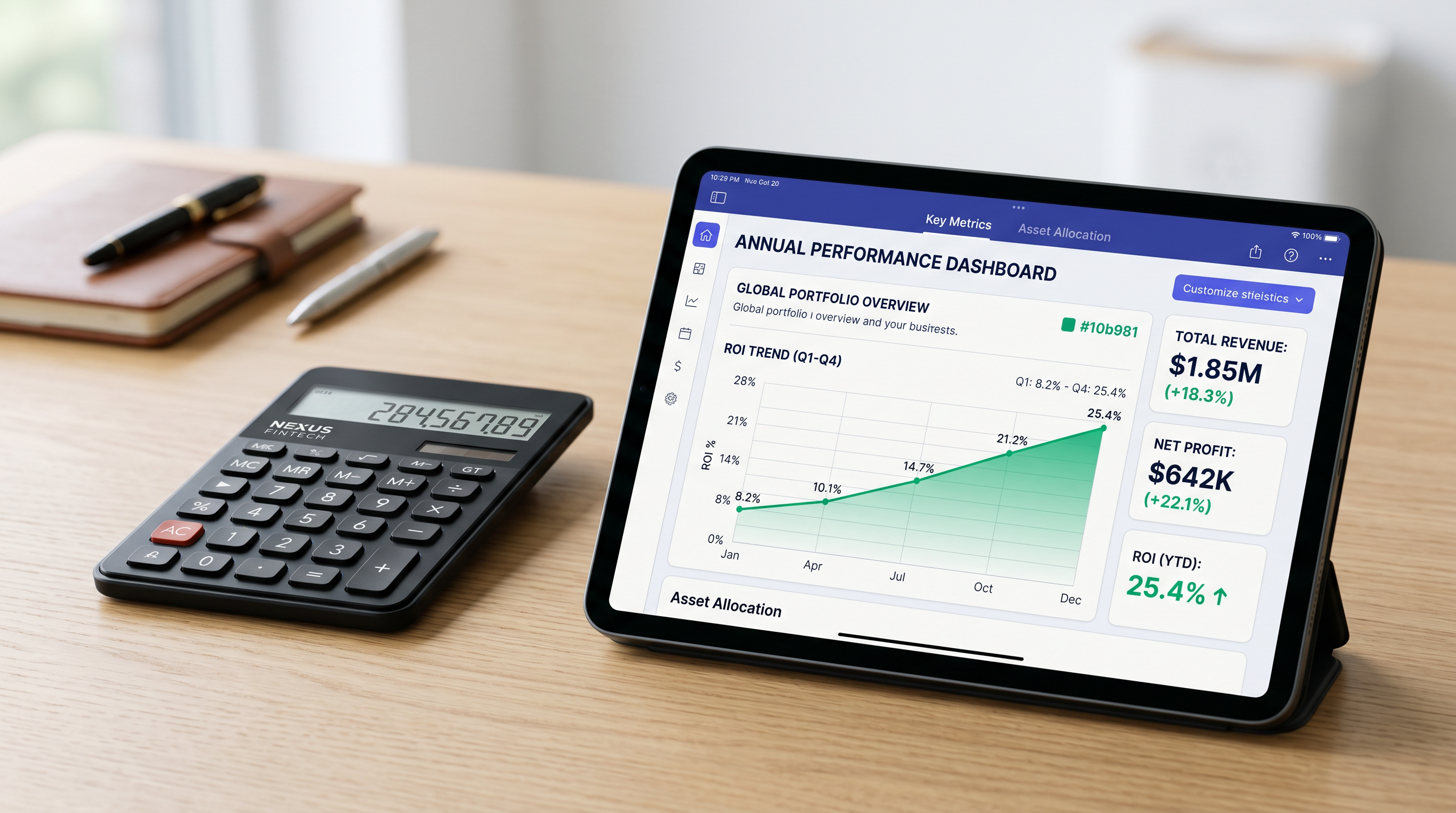
How to Calculate ROI Percentage: Formula, Examples & Free Calculator Guide
You invested $5,000 and got back $6,500 — what's your percentage return? It's a question that echoes through boardrooms, trading floors, and marketing war rooms every day. The answer? A crisp 30% ROI. But here's the kicker: without mastering how to calculate ROI percentage, you're flying blind on whether that stock pick, ad campaign, or real estate flip truly paid off. In a world where every dollar counts, understanding the return on investment formula percentage isn't just smart — it's essential for investors chasing alpha, business owners scaling operations, and marketers proving their spend.
This guide cuts through the noise. We'll break down the formula, walk through vivid examples from stocks to digital ads, tackle advanced twists like annualized returns, and arm you with pitfalls to dodge. By the end, you'll wield ROI like a pro — and even snag a free tool to crunch numbers instantly. Let's turn those investments into insights.
What Is ROI Percentage and Why Does It Matter?
ROI percentage — or percentage return on investment — measures the efficiency of an investment. It tells you, in plain numbers, how much profit (or loss) you made relative to what you put in. Picture it as a scoreboard: 100% means you doubled your money; negative figures signal a wipeout.
For investors, it's the pulse-check on portfolio health. Business owners use it to greenlight expansions. Marketers? They live by it to justify budgets to skeptical CFOs. Unlike raw profit, ROI levels the playing field — comparing a $10K stock trade to a $100K property deal becomes apples-to-apples.
In volatile markets or cutthroat ad auctions, ignoring ROI is like navigating without a compass. Get it right, and you spot winners early; miss it, and sunk costs drag you down.
The Return on Investment Formula Percentage: Your Core Equation
At its heart, the return on investment formula percentage is deceptively simple:
ROI% = (Net Return / Cost of Investment) × 100
Break it down:
- Net Return: Total gains minus total costs. Gains could be revenue, sale price, or dividends; costs include your initial outlay plus extras like fees.
- Cost of Investment: Every dollar spent to make it happen — principal, commissions, upkeep.
- × 100: Converts the ratio to a percentage for easy reading.
This formula shines because it's versatile. Plug in numbers from any sector, and it spits out truth.
How to Calculate ROI Percentage: Step-by-Step Guide
Step 1: Tally Your Costs
List everything. For a stock? Initial buy plus broker fees. Marketing? Ad spend, creative production, tools. Be exhaustive — hidden costs kill returns.
Step 2: Measure Net Gains
Subtract costs from total returns. Sold shares? Sale price minus buy price. Campaign revenue? Track attributable sales only.
Step 3: Divide and Multiply
Net Return ÷ Cost of Investment, then × 100. Boom — your ROI percentage.
Pro tip: For quick math, use an ROI calculator percentage tool like the one at PercentPro's homepage. It handles the crunching so you focus on strategy.
Real-World Examples: Calculating ROI Percentage in Action
Example 1: Stock Investment — From $1,000 to $1,250
You buy shares for $1,000. Six months later, they hit $1,250. No dividends, ignore fees for simplicity.
Net Return = $1,250 - $1,000 = $250
ROI% = ($250 / $1,000) × 100 = 25%. Solid for a short hold — beats many savings accounts.
Example 2: Marketing Campaign — $2,000 Spend Yields $8,000 Revenue
A Facebook ad blitz costs $2,000. It drives $8,000 in sales. Direct attribution confirmed via pixels.
Net Return = $8,000 - $2,000 = $6,000
ROI% = ($6,000 / $2,000) × 100 = 300%. That's marketer gold — every dollar spent returned four-fold.
Example 3: Rental Property — $200K Purchase, $15K Annual Net Income
You snag a property for $200,000. After mortgage, taxes, maintenance, it nets $15,000 yearly.
Net Return = $15,000
ROI% = ($15,000 / $200,000) × 100 = 7.5%. Steady cash flow, with appreciation upside.
Advanced ROI Concepts: Annualized ROI, Profit Margin, and CAGR
Annualized ROI: Accounting for Time
Basic ROI ignores holding periods. Annualized ROI fixes that: [(1 + ROI)^(1/Years)] - 1, then × 100. That stock at 25% over six months? Annualized: ~56%. Time is money — this evens multi-year bets.
ROI vs. Profit Margin
Profit Margin = (Revenue - Costs) / Revenue × 100. It gauges overall business health (e.g., 20% margin on $10M sales). ROI drills into specific investments. A high-margin biz can have lousy project ROI — don't confuse them.
ROI vs. CAGR (Compound Annual Growth Rate)
CAGR smooths bumpy returns over time: [(End Value / Start Value)^(1/Years)] - 1 × 100. Ideal for long-term portfolios. ROI snapshots one cycle; CAGR trends the marathon.
Common Mistakes When Calculating ROI Percentage
Even pros slip. Avoid these:
- Forgetting Fees and Taxes: Broker commissions, capital gains tax — they erode net returns. Always net them out.
- Ignoring Opportunity Cost and Time: $10K tied up earning 5%? Factor what else it could've done. Use annualized for fairness.
- Overattributing Revenue: Marketers, beware vanity metrics. Only count sales causally linked to spend.
- One-Off vs. Recurring: A rental's ROI repeats yearly; a flip doesn't. Context matters.
Industry Benchmarks for ROI Percentage
Benchmarks vary wildly:
- Stocks: S&P 500 averages 7-10% annually. Day trading? 20%+ for stars, losses for most.
- Digital Marketing: Google Ads: 200-400%. Email: 3,600% lifetime. Social: 100-300% for top performers.
- Real Estate: Rentals 6-12% cap rate. Flips: 10-20% after rehab.
- Small Biz: 15-30% target for new ventures.
Beat your benchmark, celebrate. Lag? Diagnose and pivot.
Free ROI Calculator Percentage: Simplify Your Math
Why spreadsheet wrestling when PercentPro delivers instant precision? Head to the home page at getpercentconvert.com, plug in costs and returns, and get your ROI calculator percentage readout. Handles stocks, campaigns, properties — even annualized. Free, fast, foolproof. Bookmark it; your future self thanks you.
Master ROI Percentage — Invest Smarter Today
From that initial $5K to $6.5K flip (hello, 30%), ROI percentage demystifies decisions. You've got the formula, examples, pitfalls, and a free calculator in your corner. Now, audit that portfolio, scrutinize that next campaign, value that property right.
In the end, ROI isn't just a number — it's your edge in an uncertain world. Calculate boldly, act wisely, and watch returns compound.