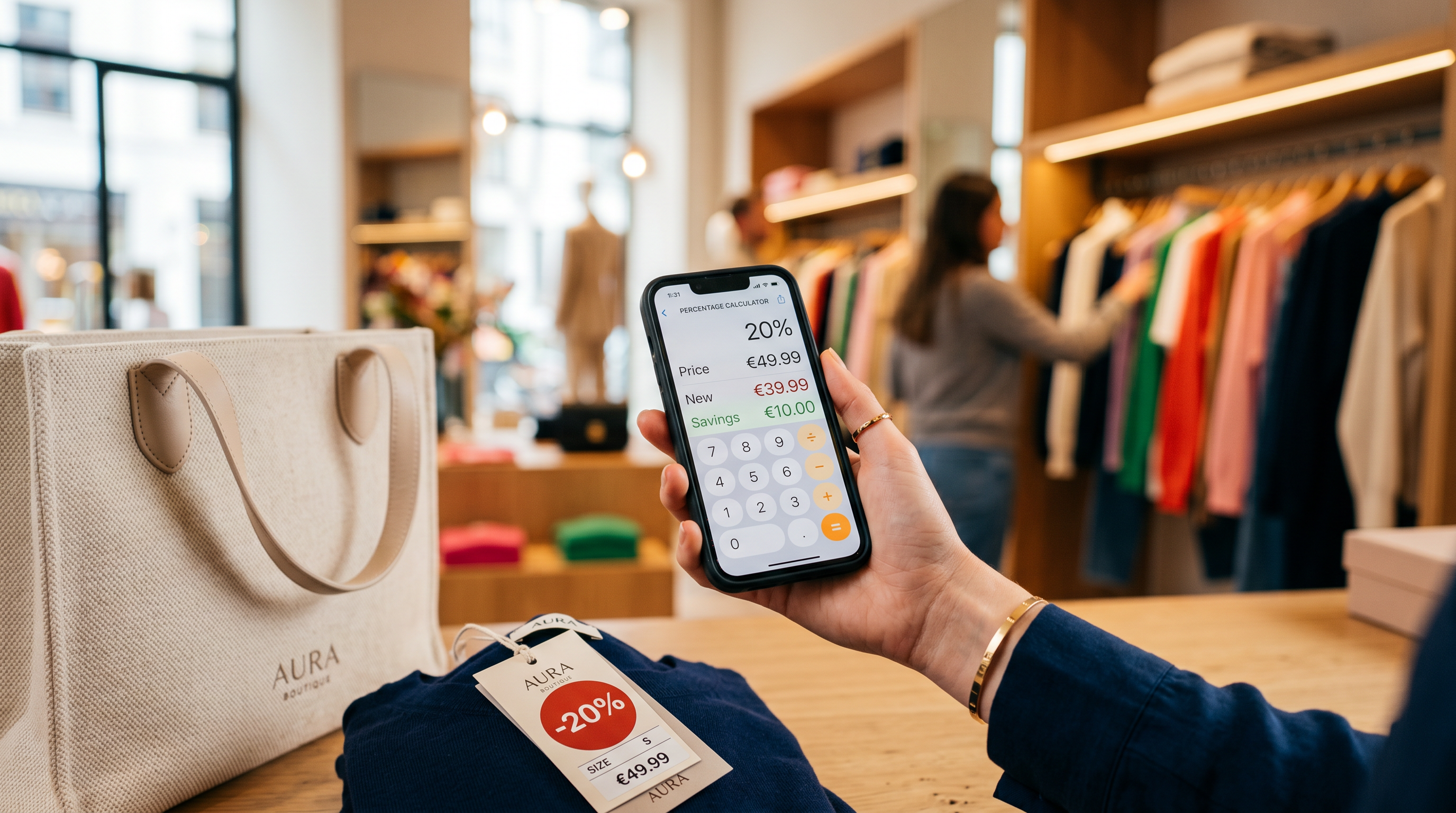
How to Calculate Discount Percentage: Quick Math Hacks for Smart Shopping (Free Calculator)
Picture this: you're strolling through a bustling department store during the holiday sales frenzy, eyes locked on a sleek leather jacket tagged at $120 with a bold "30% off" sticker screaming savings. Your heart races—do the math in your head, and it feels like a steal. But wait, is it really? In a world of flashy signs and psychological ploys, knowing how to calculate discount percentage isn't just a math trick; it's your secret weapon against overspending. Smart shoppers, budget-conscious families, and even retail pros swear by these quick hacks to stretch every dollar further. This guide dives deep into the formulas, real-world examples, and mind-bending deals that could save you hundreds annually. Ready to turn shopping into a savvy game? Let's crunch the numbers.
Why bother? Retailers design discounts to dazzle, but without precise calculations, you might grab a "bargain" that's no better than full price elsewhere. Mastering these skills empowers you to spot true value, negotiate like a pro, and build a bulletproof budget. Whether it's Black Friday blowouts or everyday grocery runs, these math hacks prevent impulse buys and reveal hidden costs—or windfalls.
The Basic Formula: How to Calculate Discount Percentage Step by Step
At its core, calculating discount percentage is straightforward math that demystifies any sale tag. The golden formula is:
Discount Percentage = (Discount Amount ÷ Original Price) × 100
Break it down:
- Discount Amount: The dollar savings, found by subtracting the sale price from the original price.
- Original Price: The full, pre-discount sticker price—your anchor point.
- × 100: Converts the decimal to a readable percentage.
Let's apply it to a coffee maker priced at $200, now on sale for $150. Discount amount = $200 - $150 = $50. Plug in: ($50 ÷ $200) × 100 = 0.25 × 100 = 25%. Boom—25% off, confirmed. This isn't guesswork; it's precision that spots if that "50% off" label matches reality. Practice on your next receipt, and you'll never overpay again.
Pro tip for retail pros: Use this in inventory audits to verify promo accuracy, ensuring compliant pricing across stores.
Finding the Final Sale Price: A Foolproof 3-Step Process
Step-by-Step with Real Shopping Examples
Knowing the percentage is half the battle; nailing the final price seals the deal. Here's the 3-step ritual:
- Calculate the discount amount: Original Price × (Discount % ÷ 100).
- Subtract from original: Original Price - Discount Amount.
- Double-check with multiplier: Original Price × (1 - Discount % ÷ 100) for speed.
Take that $120 jacket at 30% off—a wardrobe staple eyeing your cart. Step 1: $120 × 0.30 = $36 discount. Step 2: $120 - $36 = $84. Step 3: $120 × 0.70 = $84. Matches! Imagine snagging it for your winter getaway; this math confirms it's under $90, budget intact.
For bigger hauls, like a $500 TV at 25% off: Discount = $125, final = $375. Or groceries: $40 cart at 20% = $8 off, $32 total. These steps scale from impulse candy to appliance splurges, keeping your wallet happy.
Reverse Calculation: Figuring Out Percent Off from Sale Price
Ever spot a slashed price without the percentage? No problem—use the reverse discount calculator logic: ((Original Price - Sale Price) ÷ Original Price) × 100. It's how to figure out percent off when labels play coy.
Example: Stylish shoes, original $80, now $60. Discount amount = $20. ($20 ÷ $80) × 100 = 25%. Sneaky, right? That "was $80" tag just revealed its true cut.
For pros comparing competitor pricing, this uncovers effective discounts. Try our free tool at reverse percentage calculator for instant results—no app downloads needed.
Relatable scenario: Flea market find, $150 vase down to $105. Reverse math: ($45 ÷ $150) × 100 = 30% off. Haggling power unlocked!
Stackable Discounts: Why 20% + 10% Isn't 30% Off
Retailers love stacking: "20% off, plus an extra 10% for loyalty!" Sounds like 30%, but math says no. Each applies sequentially to the new price.
$100 gadget case study:
- First 20%: $100 × 0.80 = $80.
- Extra 10% on $80: $80 × 0.90 = $72.
- Total savings: $28 off—28%, not 30%.
Formula: Original × (1 - First %) × (1 - Second %). For three layers? Multiply multipliers. Picture your holiday haul: $200 toys at 25% + 15% + 10% = $200 × 0.75 × 0.85 × 0.90 ≈ $114.75. True 49% off! Budget shoppers stack coupons this way; pros forecast promo impacts.
BOGO Math Decoded: Free vs. 50% Off Breakdown
Buy One Get One (BOGO) deals dazzle, but not all equal. "Buy One Get One Free"? Pure 50% average savings. "Buy One Get One 50% Off"? Only 25% per item.
| Deal Type | Item Price | Total for 2 | Effective % Off Per Item |
|---|---|---|---|
| BOGO Free | $50 each | $50 | 50% |
| BOGO 50% Off | $50 each | $75 | 25% |
Shoes shopping? Two pairs at $80 BOGO free = $80 total (50% off each). BOGO 50% = $80 + $40 = $120 (25% off). Always clarify—stock up socks wisely!
Shopping Psychology: Anchoring, Decoys, and the 99-Cent Trick
Math alone isn't enough; brains play tricks. Anchoring: High original prices ($300 crossed to $150) make 50% feel massive—even if market value is $140. Counter: Research averages first.
Decoy pricing: Three options—small $10, medium $25 (meh), large $30. Medium decoys push large. Calculate value per unit to win.
99 endings: $9.99 scans cheaper than $10, despite pennies. Your discount math cuts through: focus on totals.
Real life: Grocery aisle, $4.99 yogurt pack vs. $5 bulk. Percent off original reveals bulk's 20% edge. Arm yourself—psychology loses to numbers.
Master These Hacks and Shop Smarter Forever
From basic formulas to BOGO breakdowns and psych shields, you've got the toolkit: calculate discount percentages swiftly, reverse-engineer deals, stack wisely, and see through sales smoke. That $120 jacket? Now $84 in your closet, not regret. Shoes at 25% true off? Yours. These aren't abstract equations—they're daily wins for budget heroes.
Retail pros: Train teams for error-free promos. Families: Weekly math nights build habits. The universe of savings awaits.
Ready for effortless crunching? Jump to our free discount percentage calculator on the PercentPro homepage. Input prices, get percentages—instantly. Shop smart, save big.