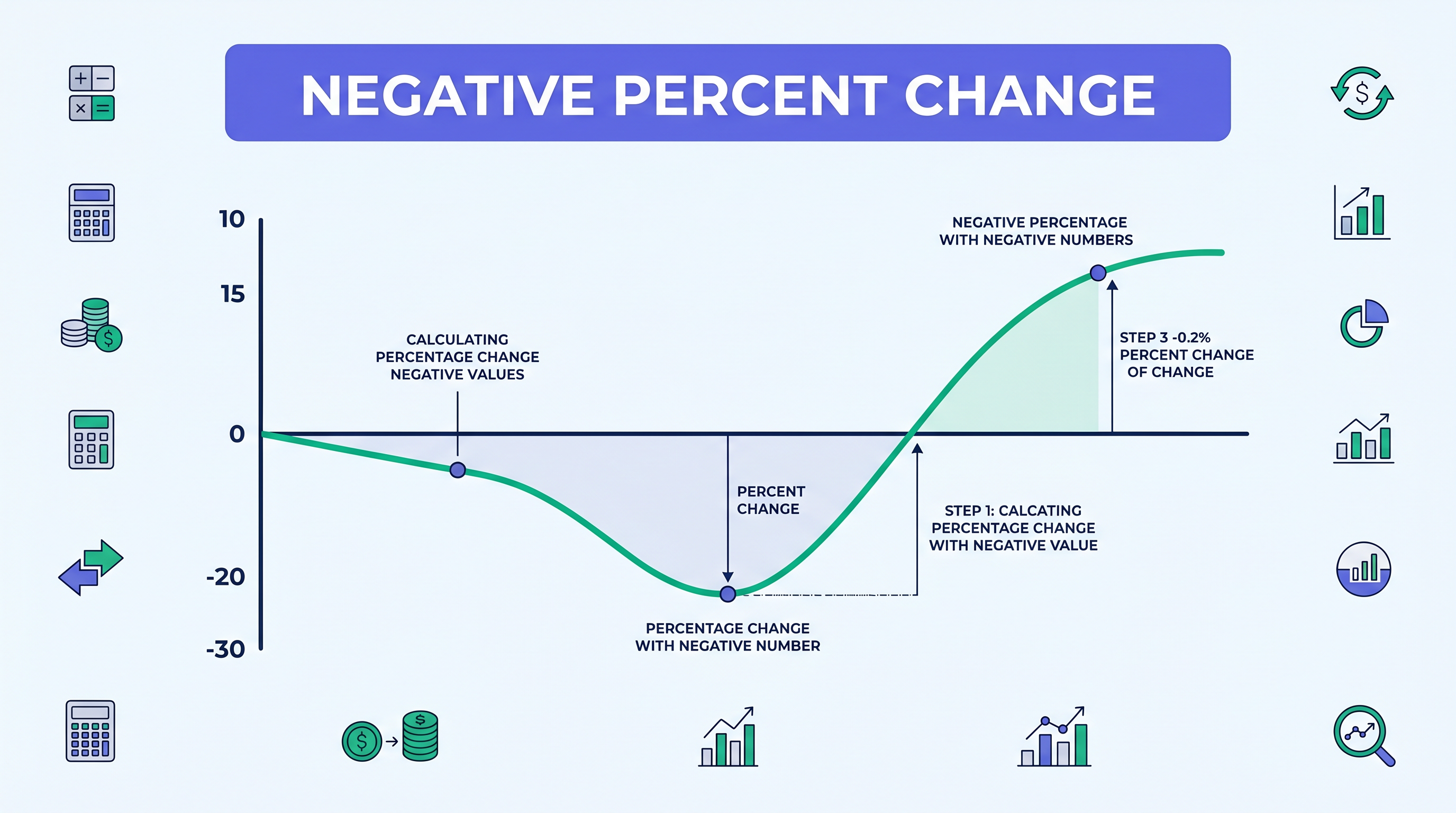
How to Calculate Percent Change with Negative Numbers: Formulas, Examples & Pitfalls
Picture this: your company's quarterly profit margin swings from a grim -12% to a hopeful +8%. Intuition screams a massive turnaround—a 20-point swing toward the black. But plug those into the standard percent change formula, and you get a baffling -166.67%. Suddenly, what feels like victory looks like catastrophe on paper. This head-scratching scenario is the reality for finance pros, students crunching exam problems, and analysts tracking volatile metrics like stock returns or sales dips.
Calculating percentage change with negative numbers trips up even seasoned number-crunchers. The classic formula falters when values flip signs or stay submerged in the red, yielding counterintuitive results that mislead stakeholders. In this guide, we'll demystify the chaos: dissecting pitfalls, unveiling reliable formulas including the absolute value approach, and walking through real-world examples from profit/loss statements to temperature shifts. By the end, you'll wield these tools with confidence—and know when to reach for our handy Percent Change Calculator to double-check.
The Standard Percent Change Formula: Simple, Yet Slippery with Negatives
At its core, percent change measures how much a value has shifted relative to its starting point. The standard formula is straightforward:
Percent Change = [(New Value - Old Value) / Old Value] × 100%
This works like a charm for positive-to-positive shifts. Say sales jump from $100 to $150: [(150 - 100) / 100] × 100% = 50% increase. Clean, intuitive.
But introduce negatives, and the denominator becomes a wildcard. Division by a negative flips the sign, distorting whether the change signals improvement or decline. Worse, if the old value nears zero from the negative side, results explode toward infinity—practically useless for reports.
Common Pitfalls When How to Calculate Percent Change When One Number Is Negative
- Sign Reversal: A loss shrinking from -$200 to -$100 should feel like progress, but the formula spits out -50%. Why? The negative denominator inverts the positive numerator.
- Implausible Magnitudes: From -$100 to +$50? Standard calc: [(50 - (-100)) / -100] × 100% = -150%. A 150% "decline" for flipping to profit? Absurd.
- Positive-to-Negative Swings: Profits turning to losses get exaggerated negatives, fine for alarm bells but often overwhelming.
- Near-Zero Trap: Old value -$0.01 to +$1? Division yields thousands of percent—technically correct, but contextually nightmarish.
These quirks aren't bugs; they're math's unflinching logic. But in boardrooms or spreadsheets, they breed confusion. Enter the absolute value formula, a practical fix for cleaner insights.
Percent Change Formula Negative to Positive: Enter the Absolute Value Approach
To sidestep sign drama, replace the denominator with the absolute value of the old value. This normalizes the baseline to its magnitude, preserving directional sense:
Absolute Value Percent Change = [(New Value - Old Value) / |Old Value|] × 100%
Here, |Old Value| strips the sign, treating -$100 and +$100 as equal-sized anchors. The numerator retains the raw difference, so positive changes stay positive (improvement), negatives stay negative (worsening).
Test it: From -$100 to -$50. Absolute formula: [(-50 - (-100)) / 100] × 100% = (50 / 100) × 100% = +50%. Halving losses? Crystal-clear win.
From -$100 to +$50: [(50 - (-100)) / 100] × 100% = (150 / 100) × 100% = +150%. Boom—triumph quantified.
This absolute value percentage change shines for volatile datasets, like crypto prices or quarterly earnings. It's not perfect—zero old values still crash it—but for most cases, it's a game-changer.
Scenario Breakdown: Navigating All Negative Combinations
Positive to Negative: The Red Ink Rush
Profits evaporate into losses. Standard formula amplifies the doom correctly, but absolute value tempers it to magnitude.
Example: Revenue forecast $200K to -$50K miss. Standard: [(-50K - 200K) / 200K] × 100% = -125%. Absolute: [-250K / 200K] × 100% = -125% (same here, since old positive). Interpretation: 125% shortfall—stark but useful.
Percentage Increase from Negative to Positive: The Comeback Kid
This is where standard fails hardest. Absolute value rescues it.
Example: Net income -$120K (Q1 loss) to +$80K (Q2 profit). Standard: [(80K - (-120K)) / -120K] × 100% = -166.67% (huh?). Absolute: [200K / 120K] × 100% = +166.67%. Now it matches the drama of swinging $200K across zero.
Negative to Negative: Shrinking or Deepening Losses?
Both red, but direction matters. Absolute value clarifies progress.
Example: Market share -8% to -3%. Standard: [(-3 - (-8)) / -8] × 100% = -62.5% (misleading decline). Absolute: [5 / 8] × 100% = +62.5%. Truth: Substantial recovery.
Real-World Examples: From Boardrooms to Thermometers
Profit and Loss: A Retailer's Rollercoaster
Retail chain XYZ posts Q1 net loss of -$2.5M amid supply snarls. Q2 rebounds to -$1.2M. Standard formula: [(-1.2M - (-2.5M)) / -2.5M] × 100% = -52% (falsely gloomy). Absolute: [1.3M / 2.5M] × 100% = +52%. Execs cheer the halved hit—perfect for investor calls.
Flip side: Q3 profit +$1.8M. Absolute: [1.8M - (-1.2M)] / 1.2M × 100% = +250%. From loss to gain? Monumental, accurately captured.
Temperature Shifts: Weather Data Wrangling
Meteorologists track anomalies. January average -4°C, February +2°C. Standard: [(2 - (-4)) / -4] × 100% = -150% (weird for warming). Absolute: [6 / 4] × 100% = +150%. Spot-on for climate trend analysis.
Or deepening freeze: -2°C to -7°C. Absolute: [-5 / 2] × 100% = -250%. Signals sharper cold snap.
Decision Table: Which Formula for Your Scenario?
| Scenario | Old Value | New Value | Standard % Change | Absolute Value % Change | Best Use Case |
|---|---|---|---|---|---|
| Positive to Positive | +$100 | +$150 | +50% | +50% | Either |
| Positive to Negative | +$100 | -$50 | -150% | -150% | Standard (warns decline) |
| Negative to Positive | -$100 | +$50 | -150% | +150% | Absolute (shows gain) |
| Negative to Negative (Improvement) | -$100 | -$50 | -50% | +50% | Absolute |
| Negative to Negative (Worsening) | -$50 | -$100 | +100% | -100% | Absolute |
This table is your quick-reference cheat sheet. Bookmark it for Excel sessions or dashboards.
Pro Tips: Beyond Formulas, Master Interpretation
- Context is king: Pair percents with absolutes (e.g., "+150% from -$100 base = $150 swing").
- Avoid chaining: Percent changes don't compound neatly across negatives.
- Zero old values? Skip percent change; report raw difference.
- Tools save time: Plug into our Percent Change Calculator for instant, pitfall-free results.
When standard and absolute diverge, disclose both. Transparency builds trust in your analysis.
Wrapping Up: Tame the Negatives, Own the Numbers
Percent change with negatives isn't rocket science—it's refined math for messy reality. Ditch the standard formula's traps for the absolute value powerhouse, tailored to your scenario. Whether dissecting earnings U-turns or climate wobbles, these methods deliver truth without the twist.
Numbers don't lie, but formulas can mislead. Choose wisely, interpret boldly.
Next time a negative lurks in your data, you'll smile—armed, accurate, unstoppable. Dive deeper with our calculator at /percent-change.