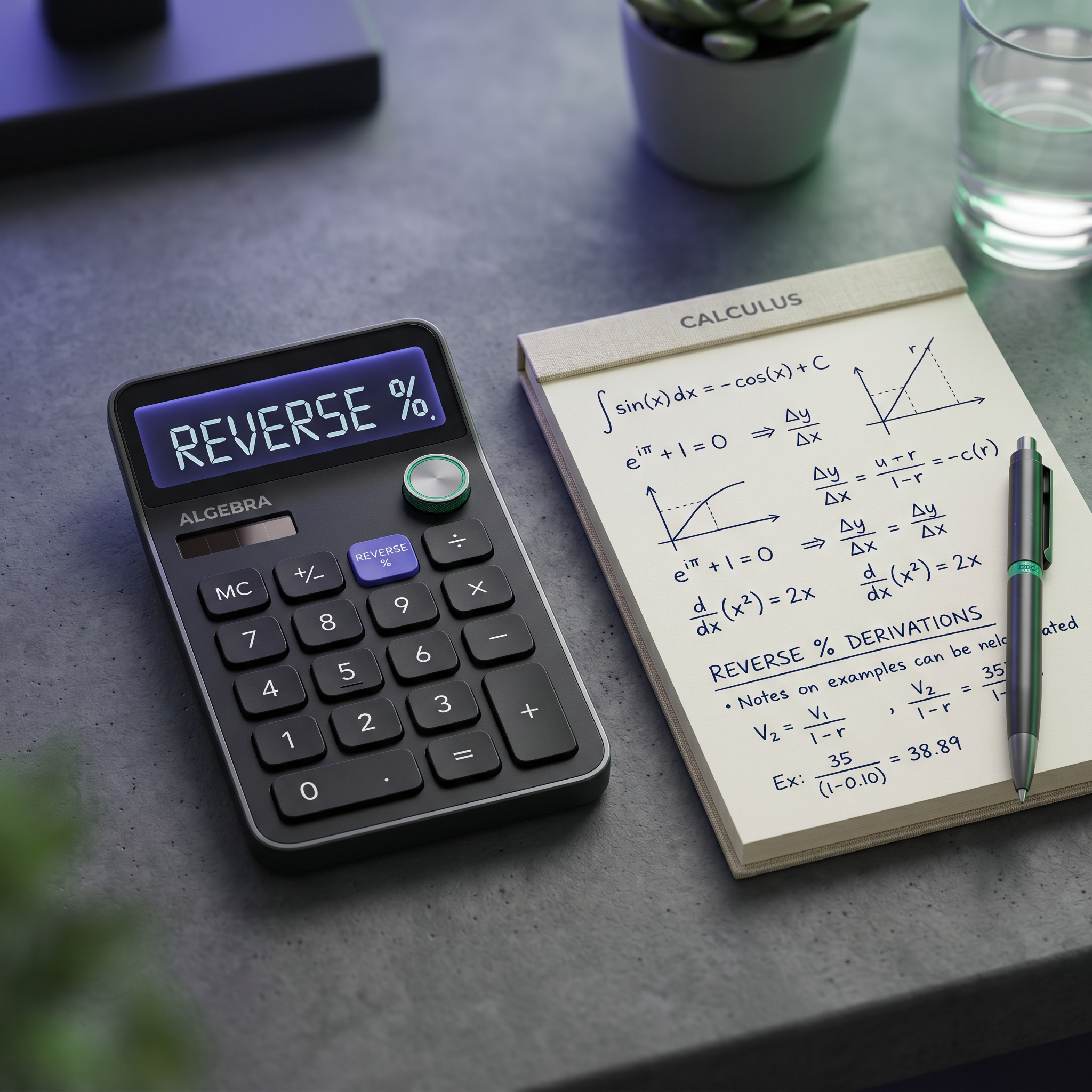
How to Calculate Original Number from Percentage: Reverse Percentage Formula Guide
Ever Stared at a Sale Price and Wondered What It Originally Cost?
Picture this: You're browsing a store, spot a jacket marked down to $80 with a "30% off" tag dangling like a promise. Your mind races— was that a steal at $100, or closer to $150? Or maybe you're splitting a restaurant bill that balloons to $57.50 after a 15% tip, and you need to know the base amount before divvying it up fairly. These moments hit students cramming for exams, finance pros auditing reports, savvy shoppers hunting deals, and business owners tracking growth. The culprit? You know the final figure and the percentage change, but the original number hides in plain sight.
Enter the reverse percentage formula—your secret weapon to find the original value from percentage changes. No more guesswork. This guide unpacks everything: the formulas, why they work, real examples, pitfalls to dodge, and quick tricks. By the end, you'll master how to calculate original number from percentage, whether it's a discount, raise, or revenue spike. Let's reverse-engineer those numbers and reclaim control.
The Reverse Percentage Formula: Your Core Toolkit
At its heart, the reverse percentage formula flips the script on standard percentage math. Instead of starting from the original and adding/subtracting a percentage, you start from the end result and work backward.
For Percentage Increases
When something grows—like a salary bump or investment return—the final amount is the original plus the increase. The formula to calculate original amount from percentage increase is:
Original = Final / (1 + percentage_increase_as_decimal)
Convert the percentage to a decimal first (15% = 0.15), add 1, then divide the final by that sum. Boom—original revealed.
For Percentage Decreases
Discounts, taxes reversed, or shrinkage? Subtract the decimal from 1:
Original = Final / (1 - percentage_decrease_as_decimal)
A 20% off sale? Use 1 - 0.20 = 0.80. Divide final by 0.80 to uncover the pre-discount price. These twin formulas power every reverse calculation, adaptable to any scenario.
Step-by-Step Algebraic Reasoning: Why It Actually Works
Math isn't magic—it's logic. Let's derive the reverse percentage formula from basics, so you see the gears turning.
For an increase: Let X be the original. A 15% hike means X + 0.15X = Final (or X(1 + 0.15) = Final). Solve for X: X = Final / 1.15. Generalize to any rate r: X = Final / (1 + r).
Decreases mirror this. 30% off: X - 0.30X = Final, or X(1 - 0.30) = Final. Thus, X = Final / 0.70, or X = Final / (1 - r).
- Identify if it's increase or decrease.
- Convert % to decimal (divide by 100).
- Build the multiplier: 1 ± decimal.
- Divide final by multiplier.
This algebraic backbone ensures accuracy, no calculator required for understanding.
Detailed Worked Examples: From Bill to Business
Example 1: Restaurant Tip (Increase)
Bill totals $57.50 after 15% tip. Pre-tip amount?
- 15% = 0.15
- Multiplier: 1 + 0.15 = 1.15
- Original = 57.50 / 1.15 = $50
Fair split achieved—each pays $10 on a $50 base.
Example 2: Sale Discount (Decrease)
Shirt $42 after 30% off. Original price?
- 30% = 0.30
- Multiplier: 1 - 0.30 = 0.70
- Original = 42 / 0.70 = $60
That $18 savings? Crystal clear now.
Example 3: Business Revenue Growth
Revenue hits $224,000 after 12% growth. Last year's figure?
- 12% = 0.12
- 1 + 0.12 = 1.12
- Original = 224,000 / 1.12 = $200,000
Owners, this uncovers true baselines for forecasting.
Common Pitfalls: The Trap That Trips Everyone
Here's the blunder: Seeing a $110 final after 10% increase and thinking, "Subtract 10% of 110 ($11), original $99." Wrong! That's $99, but check: 10% of 99 is $9.90, total $108.90—not $110.
Why? Percentages apply to the original, not final. Proper way: 110 / 1.10 = $100. The 10% of 100 is exactly $10, hitting $110. Avoid by always using the formula—saves embarrassment in meetings or exams.
- Pitfall: Applying % to final.
- Fix: Divide by (1 ± rate).
- Extra Trap: Mixing increase/decrease signs.
Mental Math Shortcuts: Quick Wins for Everyday Percents
No pencil? Hack common rates:
- 10% Increase: Final × 0.909 (or divide by 1.1: move decimal left once, adjust).
- 20% Off: Final × 1.25 (since /0.8 = ×1.25).
- 25% Off: Final × 1.333 ( /0.75).
- 50% Off: Final × 2—dead simple.
- 15% Tip Reverse: Final × 0.870 ( /1.15 ≈ ×0.87).
Retail shoppers, memorize these for lightning deal checks. Students, ace timed quizzes.
Real-World Applications: Taxes, Raises, and Investments
This isn't theory—it's daily dynamite.
Taxes (VAT/Sales Tax)
Paid $121 including 20% VAT? Original = 121 / 1.20 = $100.80. Shoppers worldwide reclaim pre-tax truths.
Salary Raises
New pay $57,600 after 8% raise? Prior salary: 57,600 / 1.08 ≈ $53,333. Finance pros negotiate from facts.
Investment Growth
Portfolio at $11,000 after 10% gain? Started at 11,000 / 1.10 = $10,000. Track real returns effortlessly.
Business owners forecast with dedicated reverse percentage calculator; everyone else, plug into the all-in-one percentage tool.
Master Reverse Percentages—Unlock Everyday Wins
You've got the reverse percentage formula: divide final by (1 ± rate). From algebraic proof to pitfalls dodged, examples etched, shortcuts sharpened— you're equipped to how to calculate original number from percentage anywhere. Students conquer math hurdles; shoppers snag true bargains; pros pierce financial veils; owners steer empires.
Next time a percentage puzzles you, pause, apply the divide, prevail. For instant precision, hit our reverse percentage calculator or the full PercentPro suite. Numbers bend to you now—what will you uncover first?