Baker's Percentage Explained: Step-by-Step Formula & How to Calculate for Perfect Bread Recipes
Picture this: It's a crisp Saturday morning, flour dusting your counter like fresh snow, and the scent of rising dough filling your kitchen. You've kneaded with passion, but your baguette slumps instead of soaring, or your sandwich loaf turns out denser than a brick. Sound familiar? The secret to bakery-level consistency lies in one simple, powerful tool: baker's percentage explained. This isn't just math—it's your ticket to flawless bread, every time, whether you're baking one loaf or a dozen rolls for the neighborhood.
In the world of home bakers and bread enthusiasts, mastering the baker's percentage formula transforms guesswork into precision. No more eyeballing water or wondering why your recipe flops at double the batch. Let's dive into this kitchen essential, step by step, and unlock the joy of perfect dough—from humble beginnings to crusty triumph.
What Is Baker's Percentage? The Flour-Centric Secret
At its core, baker's percentage is a system where the weight of flour is always 100%. Every other ingredient—water, salt, yeast, even seeds or nuts—gets expressed as a percentage of that flour weight. It's not the total recipe that equals 100%; it's the flour acting as your North Star.
Why this quirky setup? Imagine scaling a recipe from a single loaf to feed a crowd. With baker's percentages, you simply multiply everything by the same factor. Your hydration (water relative to flour) stays spot-on, delivering identical texture and rise, no matter the batch size. Professional bakers worldwide swear by it as a shared language—grab any recipe from a French patisserie or an Italian bakery, and it'll click instantly.
Quick Tip: Hydration First
Hydration percentage is water weight divided by flour weight times 100. A 70% hydration dough? Sticky but manageable, perfect for baguettes. We'll break it down soon.
Baker's Percentage Formula: Step-by-Step Guide to Calculate
Ready to master your math? Here's the bread recipe percentage formula, broken into foolproof steps. Whether you're reverse-engineering Grandma's sourdough or tweaking a new idea, this works every time.
- Weigh your flour. This is your base—always 100%.
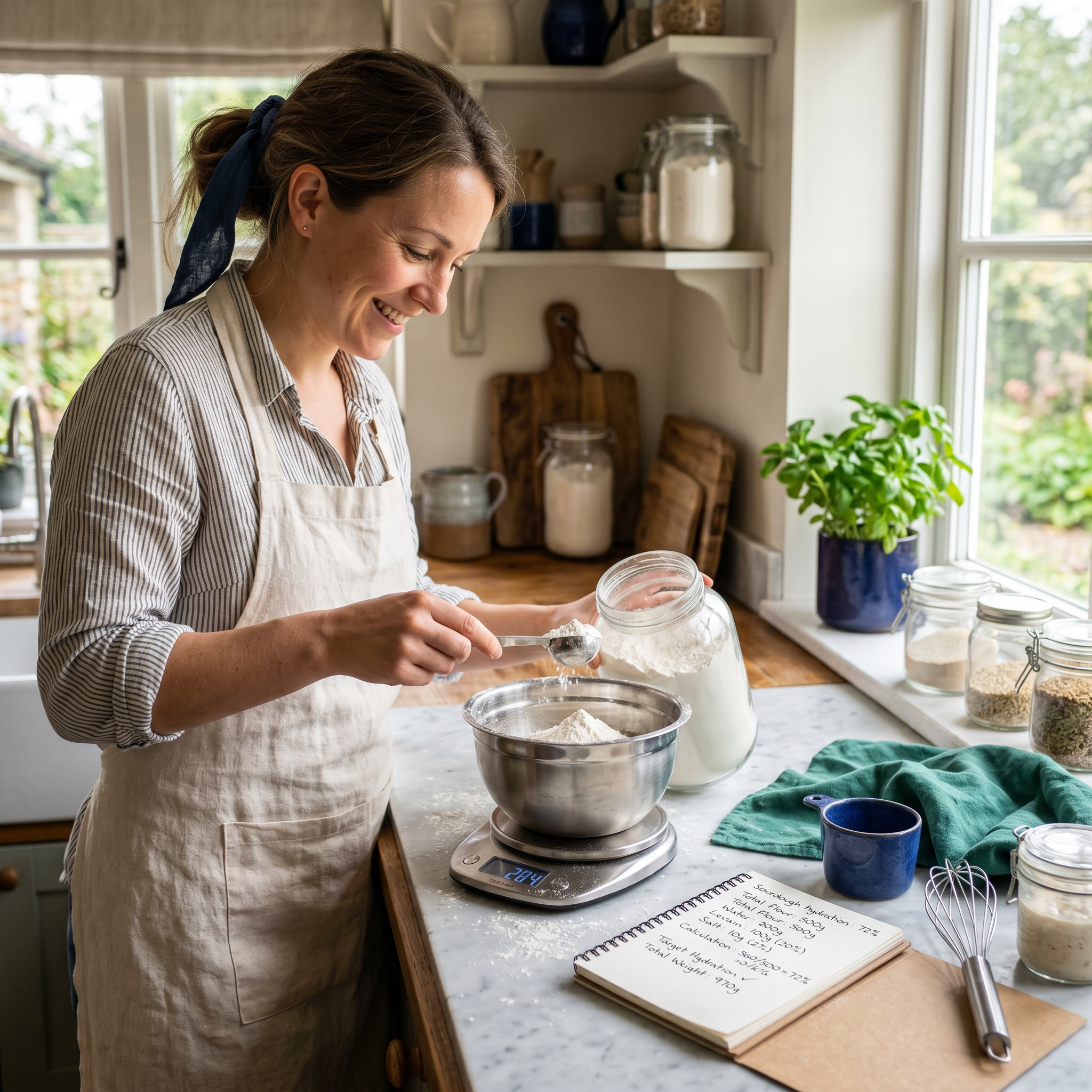
- Weigh each ingredient. Use a digital scale for precision; cups are the enemy here.
- Apply the formula: Ingredient % = (Ingredient Weight ÷ Flour Weight) × 100
- Verify totals. Flour is 100%; others add up separately (e.g., 170% total for a basic dough).
- Scale as needed. Multiply all weights by your desired factor.
Pro move: Jot percentages on your recipe card. Next bake? Boom—consistent results.
Worked Example: A Simple White Bread
Let's crunch numbers with a beginner-friendly recipe for one loaf. Flour: 500g. Water: 350g. Salt: 10g. Yeast: 5g.
| Ingredient | Weight (g) | Baker's % | Calculation |
|---|---|---|---|
| Flour | 500 | 100% | Base |
| Water | 350 | 70% | (350 ÷ 500) × 100 = 70% |
| Salt | 10 | 2% | (10 ÷ 500) × 100 = 2% |
| Yeast | 5 | 1% | (5 ÷ 500) × 100 = 1% |
Total dough weight: 865g. Hydration: 70%. Now you know how to calculate baker's percentage—easy, right?
Why Use Baker's Percentage? Vs. Standard Percentages
Standard recipes use percentages where the total mass is 100%—like 40.6% flour, 40.5% water in our example. Handy for nutrition labels, but a nightmare for bakers. Double the recipe? Recalculate everything. Baker's percentage? Flour stays 100%, multiply away.
- Ease of scaling: Intuitive for pros and hobbyists.
- Consistency: Same ratios mean same crumb, crust, chew.
- Shared language: From Tartine Bakery books to online forums, it's universal.
In your kitchen, this means fewer failures and more "wow" moments at the table.
Master Your Math: Scaling Recipes Effortlessly
Using our 500g flour recipe, let's scale. For three loaves, target 1500g flour (×3 factor).
| Ingredient | 1 Loaf (g) | 3 Loaves (g) |
|---|---|---|
| Flour | 500 | 1,500 |
| Water (70%) | 350 | 1,050 |
| Salt (2%) | 10 | 30 |
| Yeast (1%) | 5 | 15 |
Now, for a dozen rolls? Each ~70g baked weight. Total dough ~1kg (12 × ~85g raw). Flour target: ~580g (for 70% hydration yielding right total). Multiply original by 1.16. Percentages unchanged—pure magic.
This is step-by-step formulas in action: Scale fearlessly, bake confidently.
Hydration Levels: Dialing In Your Dream Dough
Hydration defines your bread's soul. Low for tight crumbs, high for open holes. Here's a cheat sheet:
- Sandwich bread: ~60%—soft, sliceable.
- Baguette: ~70%—crisp crust, chewy interior.
- Ciabatta: ~80%—rustic, airy slippers.
- Sourdough: 65-75%—tangy perfection.
Baker's Hack
Start low if you're new; high hydration rewards experience with stretchy, bubbly dough. Adjust for flour type—whole wheat absorbs more.
Experiment: Tweak one percent at a time, note results. Your kitchen journal becomes gold.
Pro Tips for Baker's Percentage Success
- Invest in a scale—grams over volume.
- Account for flour blends (e.g., 20% whole wheat? Still totals 100% flour).
- Sticky dough? Wet hands, not extra flour.
Stumped on conversions? Head to getpercentconvert.com for lightning-fast percentage math assistance.
There you have it—baker's percentage demystified. From your floured apron to the family's delighted faces, this system turns every bake into a win. Grab your scale, channel that inner artisan, and let the oven sing. Your perfect loaf awaits.