20% of 30% is NOT 50%—It's 6%! How to Calculate Percentage of a Percentage (Formula + Examples)
20% of 30% is NOT 50% — it's 6%. Here's why.
Picture this: You're editing a photo in your favorite app. The original image represents 100% of its area. You crop it down to 30% of the original size — now you've got a smaller picture. Then, you crop that result by another 20%. Does the final image represent 50% of the original? No way. It's just 6% of the starting photo. Each crop is a percentage of the previous result, not additive slices from the whole.
This "cropping a photo twice" analogy captures the essence of calculating a percentage of a percentage, or percent of a percent. It's a concept that trips up students cramming for exams, shoppers eyeing stacked discounts, and even finance pros parsing reports. But once you grasp it, you'll wield percentages like a pro. In this guide, we'll break down the percent of a percent formula, walk through examples, debunk common pitfalls, and apply it to real life.
What Exactly is a Percentage of a Percentage?
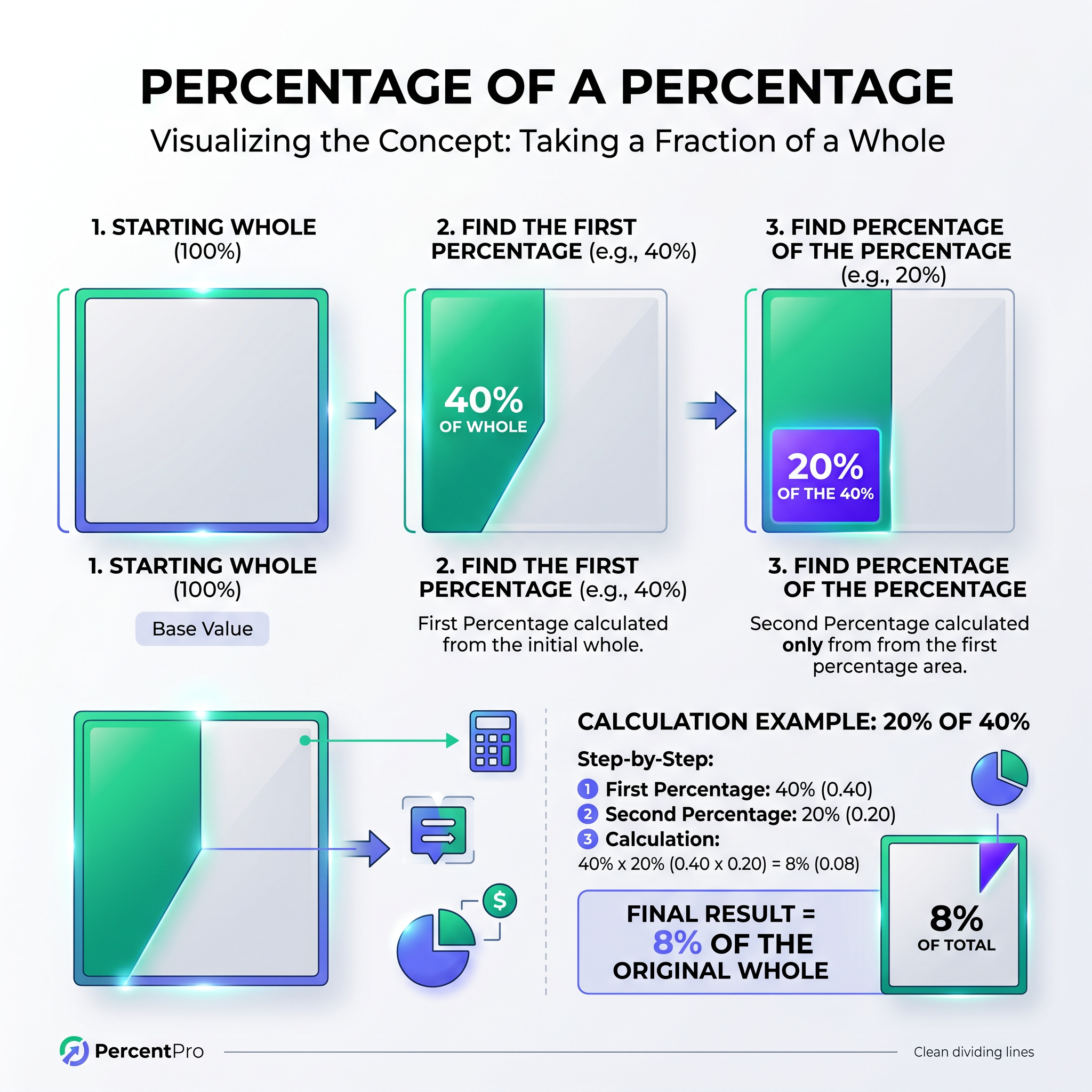
Percentages express parts of a whole: 50% means half. But when you take one percentage of another percentage, you're dealing with successive reductions or proportions. It's multiplicative, not additive.
Mathematically, if you have P1% of P2%, you're finding P1% applied to something that's already P2% of the original base. The result? A fraction of a fraction.
Successive percentages shrink (or grow) the base each time, like compound interest in reverse for discounts.
How to Calculate Percentage of a Percentage: The Core Formula
How to calculate percentage of a percentage boils down to a simple three-step process. Here's the percent of a percent formula:
- Convert both percentages to decimals: Divide each by 100. (20% = 0.20, 30% = 0.30)
- Multiply the decimals together.
- Convert the result back to a percentage: Multiply by 100 and add the % sign.
Formula in math terms: (P1 / 100) × (P2 / 100) × 100% = (P1 × P2) / 100 %
That's it. No fancy calculators needed for basics, though for precision, tools shine.
Worked Examples: Step-by-Step
Let's crunch numbers.
Example 1: 20% of 50%
- 0.20 × 0.50 = 0.10
- 0.10 × 100% = 10%
Or: (20 × 50) / 100 = 1,000 / 100 = 10%.
Example 2: 75% of 80%
- 0.75 × 0.80 = 0.60
- 0.60 × 100% = 60%
Example 3: 10% of 10%
- 0.10 × 0.10 = 0.01
- 0.01 × 100% = 1%
See the pattern? Smaller inputs yield tiny outputs — perfect for those photo crops.
Why Addition is the Most Common Mistake — And the Logical Fallacy Behind It
Ever hear someone say, "20% off plus 30% off is 50% off"? It's the siren song of sloppy math. The error stems from confusing successive percentages with parallel ones.
Logically, 20% of 30% isn't 20% + 30%. The first 30% is the base; the 20% applies to that base only, not the original 100%. Adding assumes both slice the same whole — a fallacy when bases differ.
- Parallel: Two 20% discounts on the same item? That's 40% total off the original.
- Successive: 20% off, then 20% off the remainder? Just 4% of original (0.8 × 0.8 = 0.64, or 36% off).
Students fall for it on tests; shoppers overpay. Train your brain: Multiply for chains, add only for siblings.
Real-World Applications: Percentage of a Percentage Everywhere
Stacked Retail Discounts
Black Friday alert: A $100 jacket gets 30% off ($70 left), then 20% off that ($14 more off, final $56). Total savings? 44%, not 50%. You've paid 56% of original — that's 20% of 70%, or 14% effectively.
Probability and Risk
Weather app says 30% chance of rain. You're outside 20% of the day. Chance of getting wet? 20% of 30% = 6%. Independent events multiply probabilities — a percentage of a percentage in action.
Interpreting Survey Data
Poll: 20% of voters responded; 50% of respondents favored the policy. Support among all voters? 50% of 20% = 10%. Don't mislead by ignoring the base.
Finance pros use this for portfolio yields: 5% return on a 40% allocation = 2% overall impact.
Mental Math Shortcuts for Quick Percent of a Percent Calcs
No pencil? Hack it:
- 10% of anything: Move decimal one left, then take 10% of that.
- 10% of 10%: Always 1% (0.1 × 0.1 = 0.01).
- 50% of 50%: Quarter (0.5 × 0.5 = 0.25).
- Halves pattern: n halves = 1/2^n. Two halves: 25%.
- Pro tip: (a × b)/100. For 25% of 40%: 1,000 / 100 = 10%.
Practice these, and you'll spot errors in headlines instantly.
Supercharge Your Calcs: The Go-To Tool
For instant accuracy on any percentage of a percentage, head to our homepage calculator. Plug in numbers, get results, no ads or fuss. Ideal for students verifying homework or pros in meetings.
Master Percent of a Percent — And Never Get Fooled Again
From photo crops to paycheck discounts, percent of a percent governs hidden math in daily life. Ditch addition myths, embrace multiplication, and wield the formula: (P1 × P2)/100%.
Next time a deal screams "50% total savings," pause. Calculate properly. You'll save money, ace tests, and impress colleagues. Percentages aren't enemies — they're tools for sharper decisions.
Now go forth and multiply.