Nutrition Label % Daily Value Guide: How to Calculate Percentages, Decode Facts & Use the 5/20 Rule
Picture this: You're navigating the grocery store aisles, cart half-full, when you pause at the cereal shelf. That colorful box promises "heart-healthy" wholesomeness, but the nutrition label tells a different story—20% Daily Value (%DV) for sugars in one serving. Is that a win or a warning? For health-conscious shoppers, parents stocking pantries, and nutrition students honing their skills, decoding these percentages isn't just helpful; it's essential. This nutrition label percentage guide demystifies the % daily value meaning, empowering you to make informed choices amid the sea of processed promises.
The %DV system, mandated by the FDA on most packaged foods, benchmarks nutrients against a standard 2,000-calorie daily diet. It's your compass for nutritional navigation, but like any map, it requires interpretation. We'll break down how to calculate daily value percentages for your unique needs, apply the game-changing 5/20 rule, and dissect real labels from everyday staples. By the end, those tiny numbers won't intimidate—they'll illuminate.
What Does % Daily Value Mean on a Nutrition Label?
At its core, the %DV represents the percentage of the recommended daily intake of a nutrient provided by one serving of the food. It's not the weight or volume percentage of that nutrient in the product— a common misconception that trips up even savvy readers. For instance, 10% DV for calcium doesn't mean 10% of the bar is calcium; it means one serving delivers 10% of what an average adult needs daily.
These values stem from the FDA's Reference Daily Intake (RDI) or Daily Reference Value (DRV), standardized for a 2,000-calorie diet tailored to most adults. But here's the nuance: RDIs vary by age, sex, and life stage. A lactating mother or growing teen might need far more—or less—than that baseline. Understanding this % daily value meaning transforms passive reading into proactive planning.
Key %DV reference points include:
- Total Fat: Less than 78g (based on 20-35% of calories from fat)
- Saturated Fat: Less than 20g
- Sodium: Less than 2,300mg
- Total Carbohydrates: 275g
- Dietary Fiber: 28g
- Added Sugars: Less than 50g
- Protein: 50g
Vitamins and minerals follow suit, with footnotes on labels often clarifying the 2,000-calorie basis. This nutrition facts percentage explained isn't arbitrary—it's rooted in Dietary Guidelines for Americans, updated periodically to reflect evolving science.
How to Calculate Daily Value Percentage for Your Needs
Step-by-Step: Adjusting %DV from the Standard 2,000-Calorie Diet
The label's %DV assumes 2,000 calories, but what if your needs differ? Athletes might aim for 3,000; sedentary folks, 1,800. Recalculating personalizes the data. Here's how:
- Determine your daily calorie goal. Use tools like the Harris-Benedict equation or apps based on age, weight, height, activity level.
- Find the nutrient amount per serving (listed in grams or mg before %DV).
- Calculate your personal RDI. Scale the standard proportionally. For calories-based nutrients like fat (30% of total calories), adjust: Personal fat RDI = (Your calories / 2,000) × 65g (midpoint for 20-35%).
- Compute custom %DV: (Nutrient per serving / Your RDI) × 100.
Example: A 1,500-calorie diet. Standard sodium RDI is 2,300mg. Yours: (1,500/2,000) × 2,300 = 1,725mg. If a serving has 500mg sodium (22% on label), your custom %DV is (500/1,725) × 100 ≈ 29%. Suddenly, that "low" sodium looks high.
For precision without math headaches, visit getpercentconvert.com. Input your calories and nutrient data for instant custom percentages—your shortcut to tailored nutrition label insights.
Master the 5/20 Rule: Your Fast-Track to Smart Choices
Want a thumbnail sketch without crunching numbers? Enter the 5/20 rule, an FDA-endorsed heuristic for nutrition facts percentage explained. If %DV is 5% or less, it's low; 20% or more, high. Apply to:
- Limit (aim low): Total fat, saturated fat, trans fat, cholesterol, sodium, added sugars.
- Boost (aim high): Dietary fiber, vitamin D, calcium, iron, potassium.
5% DV or less = Low | 20% DV or higher = High. Mix and match across a day's meals for balance.
This rule shines in snap judgments: A snack with 25% DV sodium? High—pair with low-sodium meals. Parents, use it to vet kid-friendly picks; students, to ace label quizzes.
Line-by-Line Breakdown: Nutrition Label Percentage Guide
Fats, Sodium, Sugars, and More
Labels list servings first—watch portions, as they're often optimistic. Then:
- Calories: Energy punch. No %DV, but track totals.
- Total Fat (9 cal/g): 5-20% DV ideal per serving. Saturated/trans: Keep under 5%.
- Sodium: High %DV links to hypertension; aim low.
- Total Carbs (4 cal/g): Focus on fiber (high good) vs. sugars (low better). Added sugars now spotlighted—under 10% calories daily.
- Protein (4 cal/g): High is bonus for muscle-building.
- Vitamins/Minerals: Updated labels emphasize vitamin D, potassium.
Footnotes reveal adjustments; ignore if your diet matches 2,000 calories.
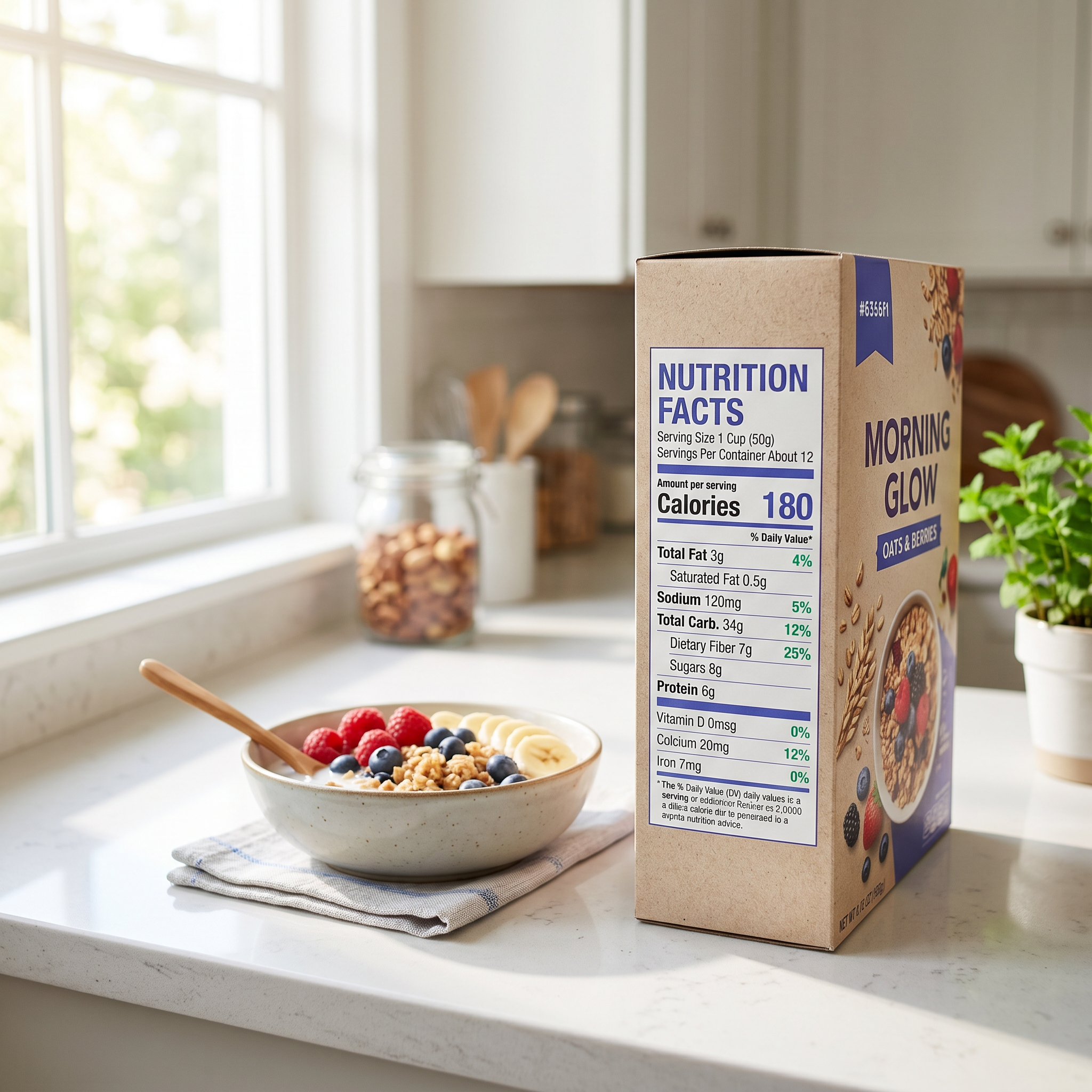
Worked Example 1: Cereal Box Label
Serving: 1 cup (30g). Calories: 120. Total Fat: 1.5g (2% DV). Saturated Fat: 0g (0%). Sodium: 200mg (9%). Total Carbs: 26g (9%). Dietary Fiber: 3g (11%). Sugars: 12g (Added: 10g—20% DV). Iron: 20% DV.
5/20 verdict: Low fat/sodium (wins), high added sugars (watch it—two bowls hit 40%). For a 1,800-calorie parent: Sugars %DV recalcs to ~22%. Solid breakfast base if portioned mindfully.
Worked Example 2: Frozen Pizza Nutrition Label
Serving: 1/4 pizza (132g). Calories: 340. Total Fat: 16g (21% DV)—high. Saturated: 7g (35%)—very high. Sodium: 830mg (36%)—high. Carbs: 38g (14%). Added Sugars: 3g (6%). Calcium: 20% DV.
5/20 flags: Fats and sodium scream moderation—one slice, not the pie. Nutrition student tip: Balance with veggie sides. Custom for 2,500-cal athlete: Fat drops to 17%—more feasible.
These breakdowns reveal how %DV shifts with context, turning labels from foes to allies.
Putting It All Together: Empower Your Plate
Mastering this nutrition label percentage guide means seeing beyond marketing gloss. Recalibrate for your calories, wield the 5/20 rule like a pro, and scrutinize line-by-line. Parents safeguard family health; students build expertise; consumers vote with carts. Next shop, that label whispers secrets—listen, calculate, conquer. Your health, decoded one percentage at a time.